

Top Math Olympiad Training for Primary School
P1 Term 3&4 Introduction
Course System Introduction
In the P1 stage, we believe the focus of children's mathematical Olympiad learning should be on the following three key points: the development of mathematical thinking and the cultivation of core mathematical skills.
The P1 curriculum is divided into two main class types: the Math High Achiever (MHA) class and the Math Olympiad Competition (CO) class.
1. Math High Achiever (MHA) Class
Content Focus: Building a framework for Mathematical Olympiad knowledge and advancing school-based learning.
Key Focus for Term 3&4: The curriculum will not only delve deeper into the foundational mathematical modules of computation and geometry but will also emphasize developing two core skills—practical application of mathematics and logical analysis—to enhance the breadth and depth of mathematical learning.

Key Modules and Core Skill Development in Lower Primary Mathematics
Computation and Geometry:
These are the two foundational pillars of mathematics learning. A solid mastery of basic mathematical tools is essential for tackling various types of math problems with confidence and ease.
Practical Application:
This is the key to creating a significant gap in mathematical ability. Practical application involves transforming abstract concepts into the ability to solve real-world problems. Only through application can the depth of understanding truly be tested, turning "knowing" into "mastering" and enabling students to distinguish themselves in mathematics learning.
Logical Analysis and Creative Thinking:
These serve as the dual engines of mathematics learning. Logical analysis forms the framework for solving problems, ensuring each step in the reasoning process is rigorous and interconnected, while creative thinking serves as the tool to break through mental barriers and discover solutions to challenging problems. Combining these two aspects allows students to stay firm and progress far when faced with complex problems.
2. Competition Olympiad (CO) Class
Content Focus: Achieving Gold in Math Olympiad Competitions and Deep Learning of the Olympiad System
Key Focus for Term 3&4:
The course will focus on tackling challenging and advanced problem types commonly found in Math Olympiad competitions. Over the two terms, it will comprehensively cover the key application problems of SASMO, helping students systematically build problem-solving strategies. Additionally, the course will place a strong emphasis on developing students' creative thinking and logical analysis skills to enhance their overall problem-solving abilities, ensuring they are well-prepared for next year's SASMO competition.

Course Schedule and Pricing Table
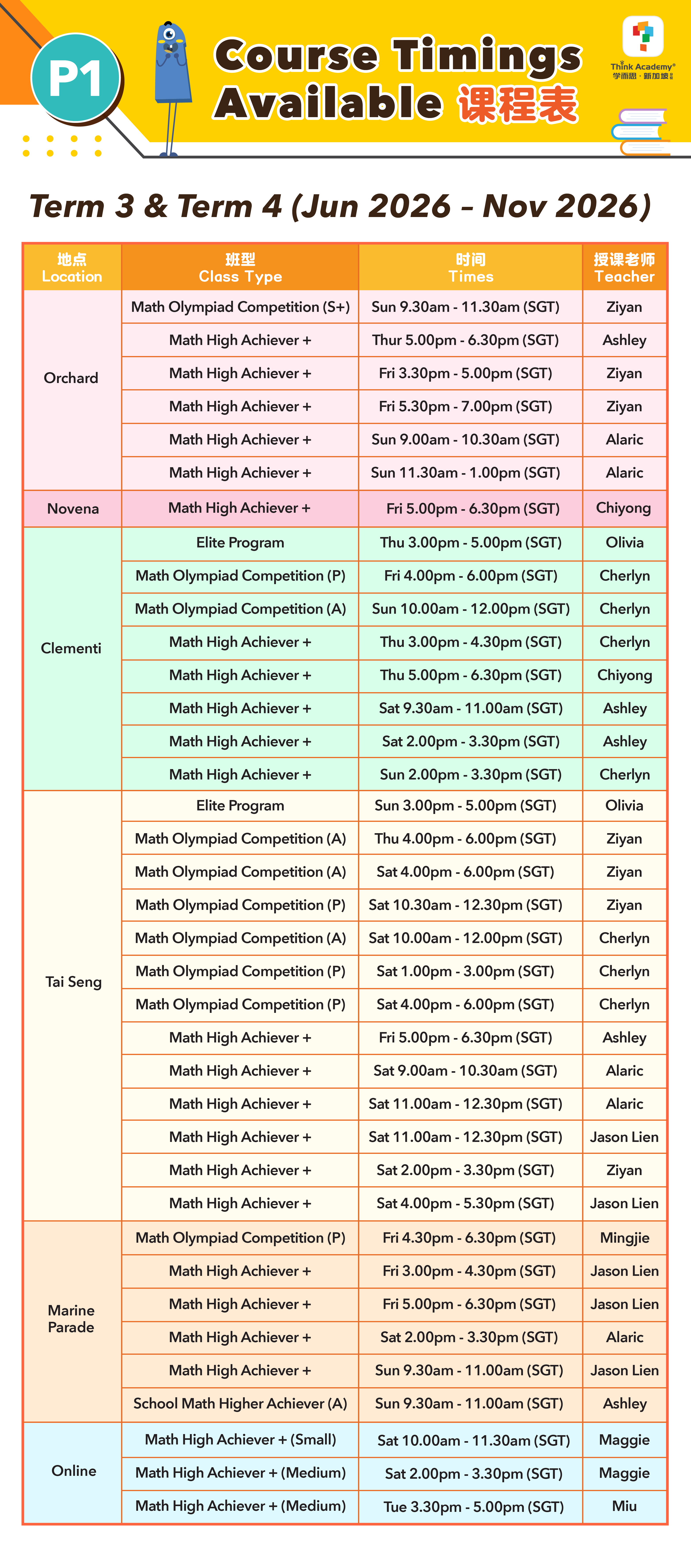

2026 Think Academy Achievement


Exclusive Exam Preparation Benefits for Enrolled Students
1. Monthly Calculation Practice:
Developing calculation skills requires consistent practice. To support this, Think Academy provides enrolled students with a monthly "Calculation Supermarket"*practice booklet, helping cultivate good calculation habits.

2. Comprehensive Course Materials and Assignments:
Each class is paired with tailored learning resources, including in-class handouts, post-class assignments, and supplemental exercise booklets, ensuring efficient and effective learning.

3. Periodic Review and Assessment System:
Younger students are at a key stage of developing healthy study habits. In addition to weekly in-class quizzes, Think Academy offers mid-year and year-end exams (along with review materials and courses) to help students consolidate their knowledge. Combined with an incentive system, this approach encourages students to review and reinforce what they’ve learned.

4. Free Exam Preparation Materials:

If you wish to register or inquire about the courses, you can contact P1 Teacher Ziyan at +65 91459628.
